
Achieve clearer, more even-looking skin with Vbeam® laser treatment at Hudson Dermatology & Laser Surgery in New York City. This advanced vascular laser precisely targets persistent redness, broken capillaries, and visible blood vessels without removing the skin’s surface.
Our board-certified dermatologists customize each treatment to your skin type, concerns, and goals, helping you achieve a naturally clearer, more balanced complexion.
15-20 minutes
1-3 days depending on treatment
Mild to moderate
Year-round with diligent sun protection
Initial improvement after 2-4 weeks, with continued improvements
Vbeam is a non-ablative pulsed dye laser (PDL) designed to treat visible blood vessels and vascular-related redness with remarkable precision.
Using a 595 nm wavelength, Vbeam delivers targeted pulses of light that are absorbed by hemoglobin, the pigment found in red blood cells. This energy selectively heats unwanted blood vessels, allowing the body to gradually clear them while minimizing damage to the surrounding skin.
This selective approach is what makes Vbeam particularly effective. Unlike ablative resurfacing lasers, Vbeam does not intentionally remove the outer layers of the skin. Instead, it targets the vascular structures responsible for redness while preserving the surrounding tissue.
The technology is rooted in the pioneering research of Dr. R. Rox Anderson and Dr. John Parrish at Harvard Medical School and Massachusetts General Hospital. Their work on selective photothermolysis helped establish the scientific foundation for modern laser dermatology, making it possible to target specific structures within the skin with greater precision.
Decades later, pulsed dye laser technology remains an important tool in dermatology, particularly for treating rosacea, visible capillaries, vascular lesions, and redness associated with acne and scarring.
Vbeam also incorporates an integrated cooling system that helps protect the skin and improve comfort during treatment, making it a convenient option for patients seeking meaningful improvement without extensive recovery.
Vbeam is most commonly used to address skin concerns associated with excess redness and superficial blood vessels.
Vbeam can help reduce persistent facial redness and visible blood vessels associated with rosacea, particularly across the cheeks, nose, and chin.
By selectively targeting the underlying vascular component, treatment can create a more even-looking complexion. Because rosacea is a chronic condition, laser therapy is often combined with appropriate skincare, medications, and trigger management.
Small, visible blood vessels, also known as telangiectasias, commonly develop around the nose, cheeks, and chin.
Vbeam precisely targets these vessels, helping reduce their visibility while minimizing damage to surrounding skin.
After acne heals, some patients are left with persistent red or pink marks known as post-inflammatory erythema.
Vbeam targets the superficial blood vessels contributing to this discoloration, helping improve the appearance of lingering redness.
Pulsed dye laser technology may also help reduce inflammation associated with certain active acne lesions.
However, Vbeam is not the primary treatment for depressed or pitted acne scars, which typically require different resurfacing or collagen-remodeling procedures.
Newer scars often appear pink or red because of increased blood vessel activity within the healing tissue.
Vbeam can help reduce scar redness and may improve the appearance of certain raised or hypertrophic scars. It is frequently combined with other treatments when additional improvement in scar texture is desired.
Cherry angiomas are small, benign red growths formed by clusters of blood vessels.
Vbeam can target these lesions and other superficial vascular irregularities, often producing noticeable improvement after a limited number of treatments.
Vbeam can address vascular redness associated with chronic sun exposure, including the red component of poikiloderma of Civatte, a condition that commonly affects the sides of the neck and upper chest.
When both redness and brown pigmentation are present, additional treatments may be recommended.
Vbeam is also used to treat certain vascular birthmarks, including port-wine stains.
These conditions generally require a specialized treatment plan and multiple sessions, depending on their size, location, depth, and response to therapy.
One of Vbeam’s greatest advantages is its ability to selectively target unwanted blood vessels while preserving the skin’s surface. This makes it possible to address several vascular concerns without the extended recovery associated with ablative resurfacing treatments.
Your dermatologist will examine your skin, identify the type and depth of the blood vessels being treated, and determine whether Vbeam is the most appropriate option.
Before your appointment:
Vbeam is generally a comfortable procedure that does not require topical numbing for most patients.
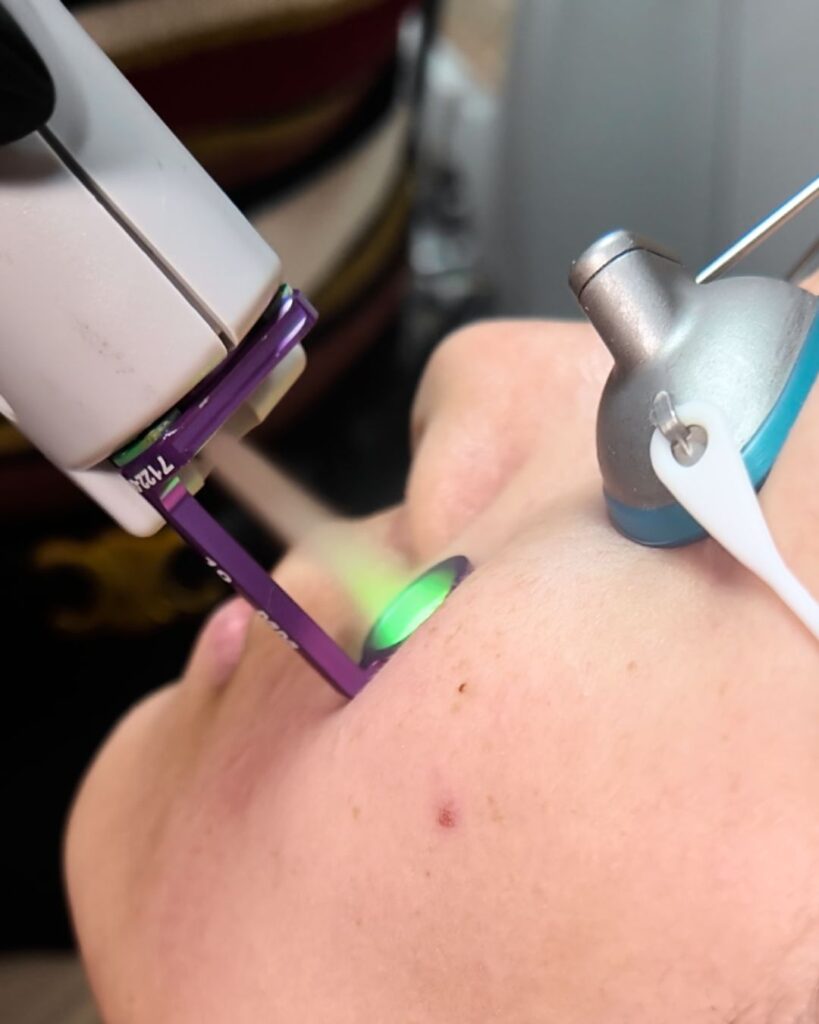
After the skin is cleansed and protective eyewear is provided, your dermatologist guides the laser handpiece over the treatment area.
The device delivers short, precise pulses of energy that selectively target hemoglobin within unwanted blood vessels.
Most patients describe the sensation as a quick snap of a rubber band against the skin. The integrated cooling system helps protect the surface and improve comfort.
Treatment typically takes just 15–30 minutes, depending on the size and number of areas being treated.
Most patients leave their appointment with mild redness or swelling, similar to a temporary flush.
With gentler, non-bruising settings, these effects typically improve within one to three days, allowing many patients to return to their usual activities almost immediately.
More intensive settings may produce temporary purple discoloration or bruising, known as purpura, which can take approximately 7–14 days to resolve.
Your dermatologist will provide personalized aftercare instructions, which may include:
Many patients begin noticing improvement within 2–4 weeks, as treated blood vessels are gradually cleared by the body.
One of Vbeam’s key advantages is its relatively short recovery period compared with more intensive laser treatments.
However, downtime depends on the treatment area, laser settings, and whether the procedure is designed to produce bruising.
The treated skin may appear flushed, slightly swollen, or feel warm.
These effects are generally mild and often improve within 24–48 hours, although swelling can occasionally last longer.
As the body gradually clears treated blood vessels, redness and vascular lesions may become less noticeable.
Many patients begin seeing improvement during this period, although some concerns require additional sessions before the full results become apparent.
Unlike ablative resurfacing, Vbeam does not usually require an extended period of surface skin healing. However, certain treatment settings intentionally produce bruising to achieve the desired vascular response.
Your dermatologist will help you plan your appointments around important events, travel, and recovery preferences.
Vbeam may be suitable for patients with different skin tones, but treatment requires careful evaluation, particularly in patients with more melanin.
The laser targets hemoglobin within blood vessels. However, melanin in the surrounding skin can also absorb some laser energy, increasing the risk of unwanted pigmentation changes.
Patients with darker skin tones may be more susceptible to post-inflammatory hyperpigmentation, hypopigmentation, or other complications when aggressive settings are used.
Our priority is to reduce unwanted redness while preserving your skin’s natural tone and minimizing unnecessary risk.
Many patients benefit from a series of 2–4 treatments, although some isolated blood vessels may respond after fewer sessions.
Diffuse facial redness, rosacea, and certain vascular birthmarks may require additional treatments.
Sessions are often spaced approximately 3–6 weeks apart, depending on the condition and your dermatologist’s recommendations.
Vbeam can successfully reduce or eliminate many treated superficial blood vessels.
However, new vessels may develop over time due to genetics, sun exposure, aging, or underlying conditions such as rosacea.
Maintenance treatments may be recommended to preserve results.
Vbeam is generally well tolerated, and topical numbing is not required for most patients.
The treatment typically feels like a series of quick snaps against the skin. The device’s cooling system helps protect the skin and improve comfort.
Some patients experience temporary warmth or tenderness afterward, but discomfort is usually mild and short-lived.
Not necessarily.
Vbeam can be performed using settings designed to minimize visible bruising, particularly when treating diffuse facial redness.
However, certain vascular conditions may respond better to settings that produce temporary purple discoloration.
When bruising occurs, it generally resolves within 7–14 days, although individual recovery varies.
Vbeam can significantly improve visible blood vessels and help reduce persistent redness associated with rosacea, but it does not cure the underlying condition.
Rosacea is chronic and may continue to cause flushing or new vascular changes over time.
For long-term management, your dermatologist may recommend combining laser therapy with prescription treatments, gentle skincare, sun protection, and trigger avoidance.
Yes. Vbeam may improve red or pink marks left behind after acne by targeting the superficial blood vessels contributing to their appearance.
Pulsed dye laser treatment may also reduce inflammation associated with certain active acne lesions.
However, it is not the primary treatment for brown acne marks or deep, depressed acne scars.
Your dermatologist may recommend additional treatments if you have a combination of discoloration and textural scarring.
The longevity of results depends on the condition being treated.
Successfully treated vessels may remain less visible for years, but new vessels can develop over time.
Rosacea and other chronic vascular conditions may require occasional maintenance treatments to help sustain improvement.
Daily sun protection and appropriate skincare can support longer-lasting results.
Many patients can resume wearing makeup within 24 hours, provided the skin remains intact and their dermatologist approves.
If significant irritation, blistering, or crusting occurs, makeup should be avoided until the affected areas heal.
Your provider will give you personalized instructions based on the treatment intensity and your skin’s response.
Yes, but timing matters.
Although many patients recover quickly, some treatments can produce redness, swelling, or bruising lasting up to two weeks or longer.
If you’re preparing for an important event, scheduling a consultation well in advance allows your dermatologist to recommend an appropriate treatment plan and recovery timeline.
Yes. Vbeam can be performed year-round when appropriate sun-protection precautions are followed.
However, freshly tanned skin can increase the risk of adverse effects, so treatment should be postponed when necessary.
Fall and winter may be more convenient for patients who spend significant time outdoors.

Persistent redness, visible capillaries, and lingering acne marks can be difficult to address with skincare alone.
Vbeam offers a precise, well-established approach to reducing these concerns, helping restore a calmer, more balanced complexion with minimal downtime for many patients.
At Hudson Dermatology & Laser Surgery in New York City, our board-certified dermatologists combine advanced laser expertise, innovative technology, and individualized treatment planning to help you achieve natural-looking results.